
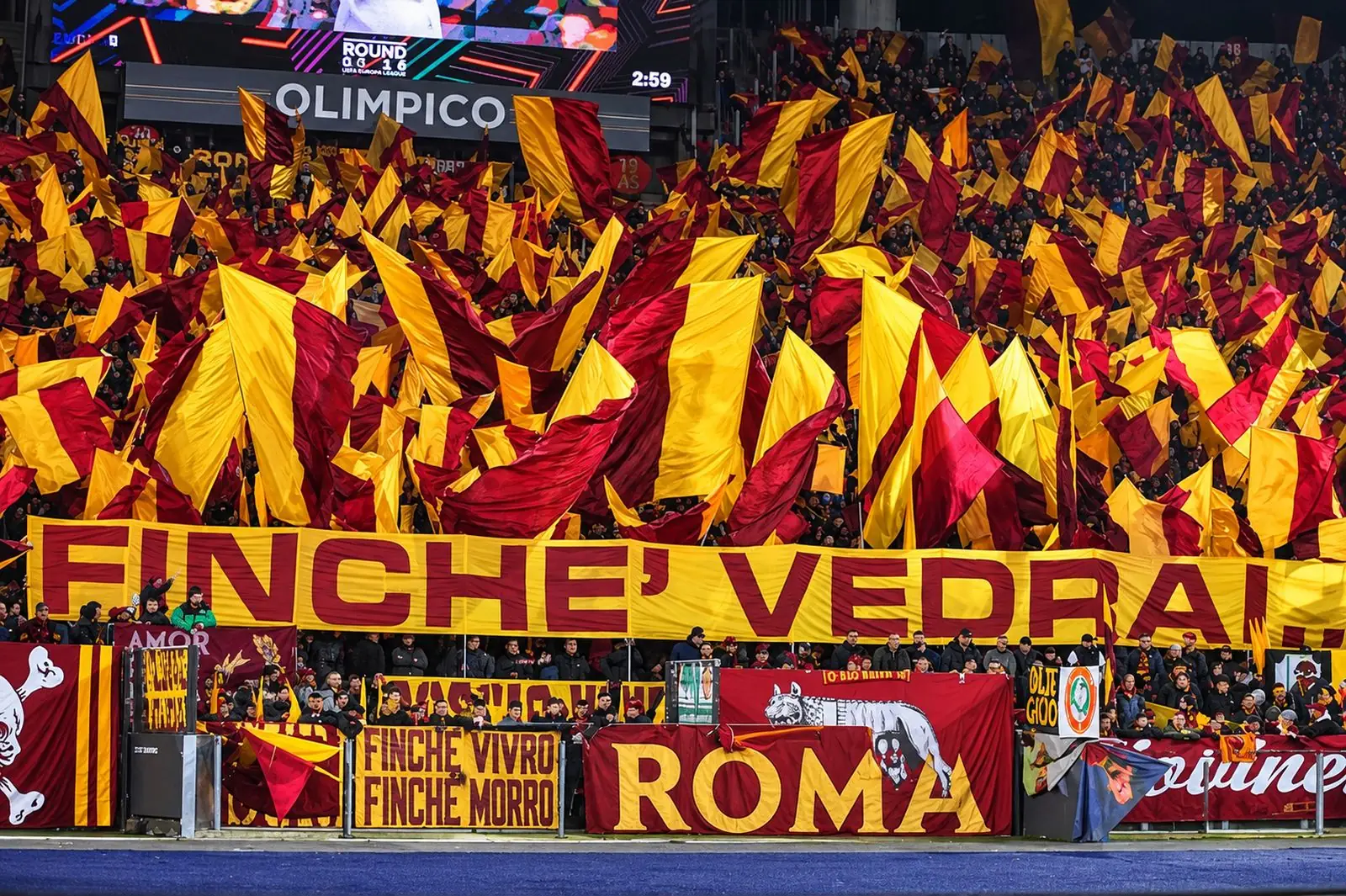
Forty-two metres of red: the day the Sud found its voice
The CUCS, 9 January 1977
Forty-two metres. White letters on a red background. Two huge flags on an old flagpole, the drums. On 9 January 1977, on the low wall of the Curva Sud at the Olimpico, a group of young fans did the thing they will be remembered for forever: they started singing and never stopped. For the whole match. Roma were at home to Sampdoria, and that day the Sud found a single voice.
In the results books that Sunday takes up one line, a 3-0 over Sampdoria like so many others. In the story of the giallorosso people it takes up a whole chapter. And it deserves to be told properly, because it is the story of how a curva became a home.
A map of Rome drawn on concrete
Roma had been playing at the Olimpico since 1953, and at the start of the 1970s the curva was a map of the city drawn on concrete. The young fans gathered by neighbourhood, each group with its own name, its own banner, its own stretch of wall to defend. In 1972 the Boys were born. The same year saw the birth of the Fedayn, who came from Quadraro and Cinecittà, and their founder was Roberto Rulli. He was thirteen. Thirteen years old. Roma's modern curva was invented by kids.
At the end of 1976 Rulli and other young fans of the Sud, among them Antonio Bongi, one of the founders of the Boys, decided to take a step that changed everything: to come together under a single name. They chose Commando Ultrà Curva Sud. To everyone it would simply become the CUCS, four letters that Romanisti still say today like the name of a family member. Different neighbourhoods, one voice. That is when the Sud stopped being many curve and became the Curva.
The same afternoon, the same date
And while a voice was being born in the stands, on the pitch Roma were celebrating. They won 3-0, and two of the goals came from a twenty-one-year-old born in the city: Agostino Di Bartolomei. The curva and its future captain found each other on the same afternoon, under the same date, without knowing it. Football writes some coincidences all by itself, and that is exactly why they are the most beautiful: on the day the Sud began to sing, the man scoring was one of its own.
A year later there were already many of them. What had begun with a few kids on the wall had become the very way the Sud lived the stadium. The Fedayn, inside the larger group, kept their own banner and their own identity, because unity never meant erasing your roots. And the curva has never forgotten who lit the spark: Roberto Rulli's name returned to the banners for years, and again in 2010.
That sound passed from father to son
The old curva no longer exists. For the 1990 World Cup the Olimpico was rebuilt and the curve redone from scratch. The banner, though, stayed in its place for twenty-two years, then the group donated it to Roma's Historical Archive along with more than a thousand objects: drums, tickets, scarves, documents, tapes with recordings of the curva.
So that red entered Roma's official memory, and on those tapes the sound of an era has been preserved. But the rest never needed an archive. Every time the Sud strikes up a chant, what comes out has been passed from mouth to mouth, from the kids to the fathers and from the fathers to their sons, Sunday after Sunday, for almost fifty years. The faces change, the stadiums change, the voice remains.
And if you listen closely, deep within that sound there is still a Sunday in January. Forty-two metres of red, two huge flags on an old flagpole, the drums. And a group of young fans who decided that day never to stop singing. They have not stopped. We will not stop.
- cucs roma
- curva sud roma history
- commando ultra curva sud
- roma ultras 1977
- fedayn roma
- roma boys
All our history · Quiz of the week
Fonti: AS Roma, la nascita del CUCS · AS Roma, lo striscione all'Archivio Storico · Gli Eroi del Calcio, Roberto Rulli · The Gentleman Ultra, AS Roma Alternative Club Guide · TuttoMercatoWeb, Geppo e il CUCS · AS Roma Ultras, scheda Di Bartolomei · Wikipedia, Stadio Olimpico